
Summer School 2026: Information Management for Public Transportation Services

As it does every year, the Institute for Transport Studies (IfV) at KIT, in collaboration with the Association of German Public Transportation Companies (VDV), hosted the course “Information Management for Public Transportation Services” from October 19 to October 23. Participants included students from various degree programs as well as employees of public transit agencies from all over Germany.
Through specialized presentations and discussions with experts from organizations such as VBK, init, IVU, MENTZ, and DB, participants gained practical insights into key topics in local public transit—ranging from legal and organizational fundamentals to traffic planning and operations management, all the way to modern IT systems.
Field trips to init and VBK rounded out the program and provided hands-on insights.
The Summer School thus offered a successful blend of theory, practice, and professional exchange.
Next year, the event will once again be offered at the Technical University of Ilmenau, RWTH Aachen University, and KIT.
IfV at the German Road and Transport Congress 2026 in Wiesbaden

From October 14 to 16, 2026, the German Road and Transportation Research Association (FGSV) brought together experts from academia and practice at the German Road and Transport Congress in Wiesbaden to discuss current challenges and developments in the transport sector. Key topics included sustainable mobility, digitalization, road safety, and innovative approaches to transport infrastructure.
The Institute for Transport Studies (IfV) at KIT was also represented at the congress. As part of the poster exhibition, Ann-Sophie Voss presented research on autonomous on-demand public transport services conducted within the KIRA research project. The research focused on the acceptance, use, and traffic-related impacts of these services.
Emre Görgülü presented his research funded by the German Research Foundation (DFG) on the microscopic modeling of service-related travel, focusing on skilled trades and outpatient care services.
The congress provided numerous opportunities for professional exchange and discussions on current research findings and practice-oriented solutions.
IfV Retreat 2026: Research in transition

On October 5 and 6, 2026, this year’s retreat took place at the "Papierzentrum" (Paper Center) in Gernsbach. Under the topic "Research in transition", we came together as an institute to address the institute’s future challenges through various working and discussion formats.
We focused on questions about the institute’s future structure and demographic change, the ever-present topic of artificial intelligence, PhD projects at the institute, and future research topics. Whether in small groups, in plenary sessions, or through individual work—the open and respectful atmosphere of discussion allowed the topics to evolve into an intensive exchange. Of course, we used plenty of sticky notes, and plenty of paper was filled with writing—after all, we rented space at the "Paper centre".
Beyond the substantive discussions, the conference also offered opportunities for personal interaction and a few lively rounds of Spikeball. Over snacks, at the bowling alley, at the pool table, or over board games, we wrapped up the day in a relaxed atmosphere. We’re now bringing these new perspectives and inspirations back into our daily work at the IfV.
Conference hEART 2026

This year, the Symposium of the European Association for Research in Transportation—hEART for short—took place in the cosmopolitan city of Paris. With three presentations, the IfV was also able to showcase its work at the conference, network, and gather new ideas. A great social program, featuring a boat ride on the Seine and a fantastic conference dinner, rounded out the event.
The following papers were presented:
🔹Capturing behavioral differences between frequent and seldom users of ride-pooling in a cross-nested logit model. Nadine Kostorz-Weiss, Michael Heilig, Martin Kagerbauer und Peter Vortisch
🔹Inverse Reinforcement Learning for Variable Speed Limit Systems. Josephine Grau, Robin Abohariri, Alexander Roocroft, Marco Rinaldi, Hans van Lint, Marvin Baumann und Peter Vortisch
🔹Where are Cars Parked at Home? Determinants of Residential Parking Location Choice. Lucas Schuhmacher, Pia Tulodetzki, Martin Kagerbauer und Peter Vortisch (presented by Pia Tulodetzki)
University Conference on Transportation 2026


Once a year, transportation departments from German-speaking countries gather at the University Conference on Transportation. This time, it took place in the tranquil town of Meissen near Dresden, known primarily for its porcelain manufactory.
A series of presentations highlighted the breadth of transportation research in Germany and Austria. Prospective doctoral students received valuable feedback on their dissertation work. There was also an opportunity for attendees to get to know one another and exchange ideas.
Even though the trip from Karlsruhe was quite long, the IfV was, of course, represented. Josephine Grau and Jelle Kübler each presented the current status of their doctoral research.
European Transport Conference 2026

From ride-pooling to mobility equity and the design of urban spaces, to urban logistics, tradespeople’s travel, and long-distance travel: At this year’s European Transport Conference (ETC) in Porto, colleagues from our institute presented research findings from a wide variety of projects and subject areas.
We were represented in the program with these six presentations:
🔹Understanding the Heterogeneity of Craft Service Travel through Qualitative and Quantitative Analysis. Emre Görgülü und Peter Vortisch
🔹Beyond fixed schedules – The landscape of ride-pooling services in Germany. Nadine Kostorz-Weiss, Martin Kagerbauer und Peter Vortisch
🔹Fifteen Minutes, Many Measures: Assessing Mobility Equity in the 15-Minute City. Stefanie Kern, Lukas Barthelmes, Friedrich Merz, Martin Kagerbauer und Peter Vortisch
🔹Streets in Transition: Citizens’ Attitudes Toward Parking, Liveability, and Urban Space. Lucas Schuhmacher, Pia Tulodetzki, Martin Kagerbauer und Peter Vortisch
🔹Aligning Urban Logistics with the 15-Minute City: Insights from an Agent-Based Parcel Demand Simulation. Lukas Barthelmes, Stefanie Kern, Constantin Krautstrunk, Emre Görgülü, Martin Kagerbauer und Peter Vortisch
🔹Stability of Journey Frequence and Mode Choice Determinants in Overnight Journeys. Anne Kathrin Lorenz, Nicolas Salbach, Miriam Magdolen und Peter Vortisch
Beyond our own presentations, we were actively involved in the conference program: Lukas Barthelmes served as session chair, moderating a “last-mile” session in the Freight & Logistics track. We found the many expert discussions and the diverse perspectives on current issues in mobility and transportation research particularly valuable. Accordingly, we’re returning from the three-day conference with many interesting discussions, new ideas, and contacts. Many thanks to the organizers, all speakers, and participants for the exciting exchange!
Company outing 2026

On September 4, 2026, the time had come once again for our institute’s annual staff outing. This year, we headed to the Technik Museum in Speyer. During a 90-minute guided tour, we gained fascinating insights into and background information on a wide variety of modes of transportation.
Afterwards, we enjoyed an impressive IMAX screening in the museum’s on-site cinema. We then had the rest of the day to explore the museum and its exhibits at our own pace.
The successful day came to a close in the evening with a summer party at our institute.
Science Camp Future Lab: Rethinking Mobility 2026
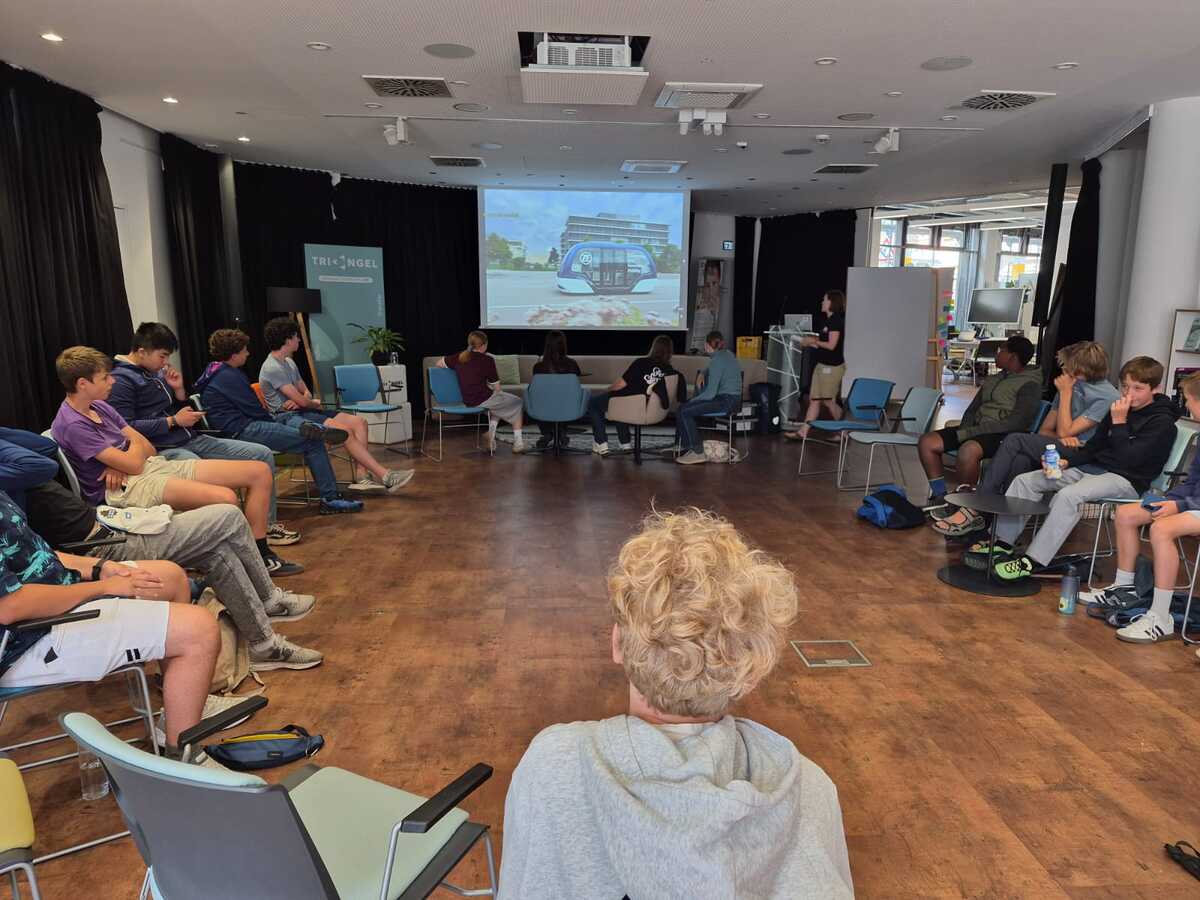
On September 2, 2026, Lisa Ecke provided students aged 11 to 16 with insights into travel behavior research as part of the Science Camp Future Lab: Rethinking Mobility. In addition to a presentation on collecting and analyzing travel behavior and an overview of current research projects at the IfV, the camp included a lively discussion about the future of travel. During the camp, the students developed their own visions for future travel and sought feedback from researchers. This led to a comprehensive exchange of ideas and highlighted the need to understand past travel patterns in order to plan for future travel needs in a way that meets actual demands.
Field Trips in Transportation Telematics
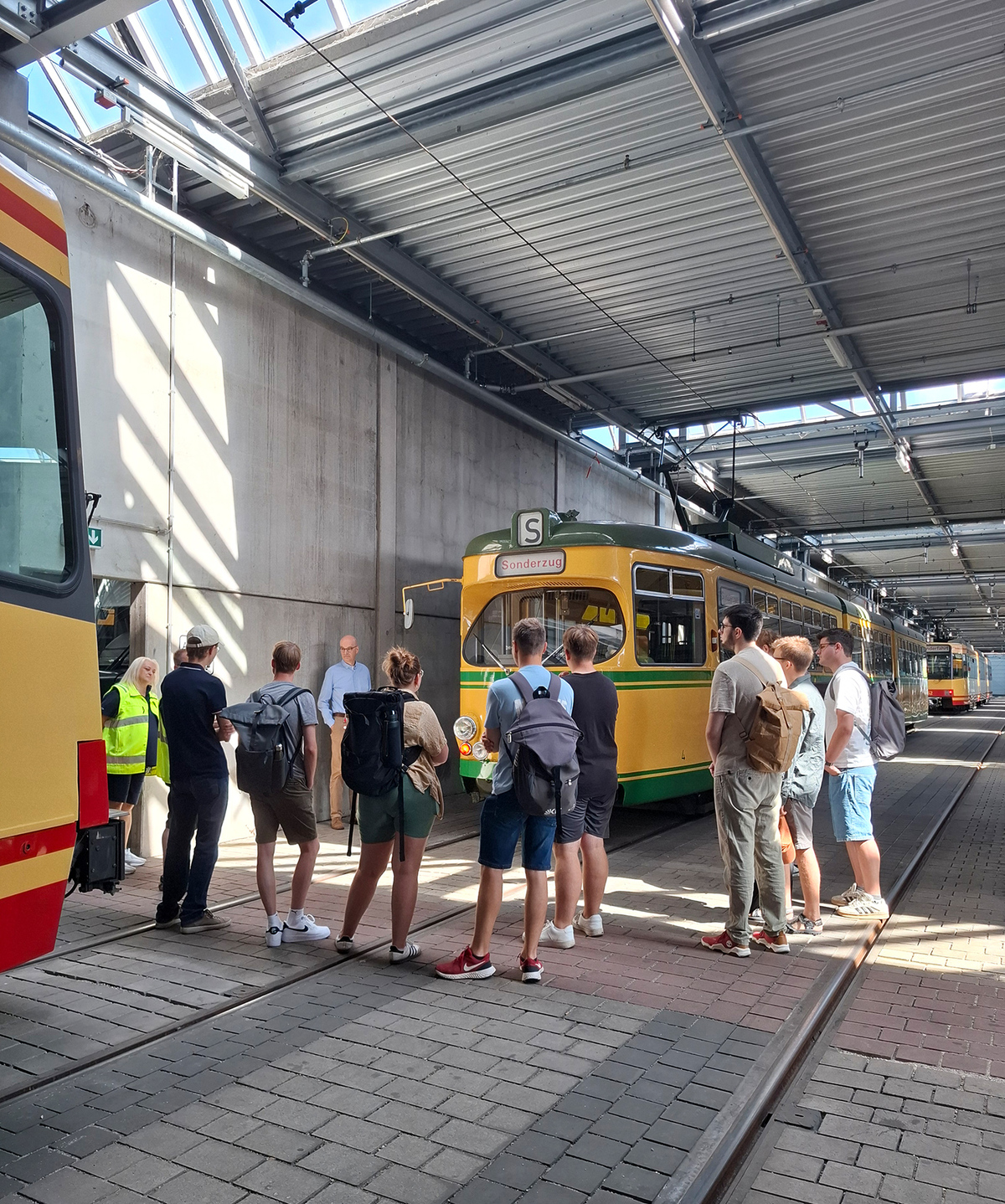
As part of the “Traffic Management and Telematics” course, three field trips were offered this semester. They gave students the opportunity to experience the course material in practice and to learn about various areas of application.
The first field trip took place at the Karlsruhe Civil Engineering Office. There, the city’s traffic computer and a traffic signal control box were presented, and their operation was explained.
During the field trip to the KVV, participants got a glimpse inside the control center. They also had the opportunity to try their hand at controlling a train.
The third field trip will take them to init, a provider of software solutions for public transportation. There, the students will gain insights into current developments in the field of autonomous driving as well as how a ticket vending machine works.
Conference WCTR in Toulouse
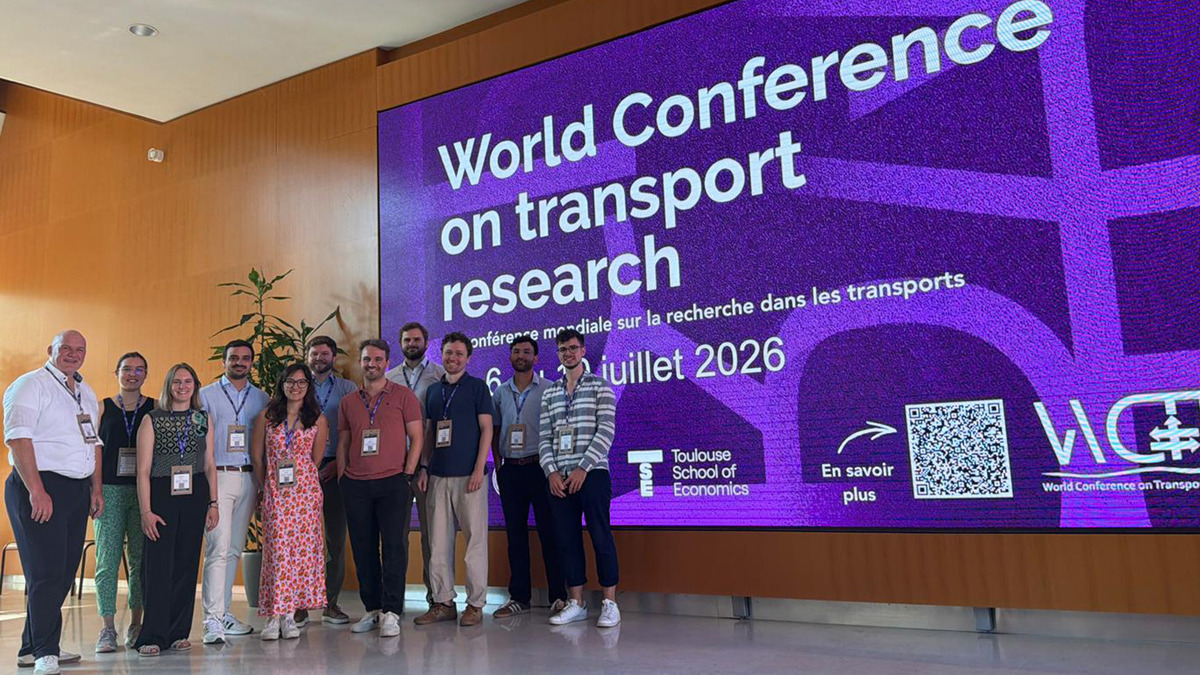
This year’s World Conference on Transport Research took place in Toulouse. Our institute was represented by eight contributions in the form of presentations and posters, allowing us to share our latest research findings with the international academic community.
🔹 Data-driven spatial identification of regions with high potential for demand-responsive (autonomous) public transport as a complement to existing services. Christian Klinkhardt, Sören Braner, Martin Kagerbauer und Peter Vortisch
🔹 Data-driven Reconstruction of Freeway Control Algorithms. Josephine Grau, Claude M. Weyland, Marvin V. Baumann und Peter Vortisch
🔹 From counts to patterns: large-scale analysis and extrapolation of bicycle volumes. Jan Vallée, Gabriel Wilkes, Stefanie Kern, Martin Kagerbauer und Peter Vortisch
🔹 Synthesizing firm populations in agent-based freight demand models using statistical learning techniques. Lukas Barthelmes, Robin Andre, Adrien Beziat, Kelly Clifton, Martin Kagerbauer und Peter Vortisch
🔹 Spatial distribution of economic status in synthetic populations. Lucas Schuhmacher, Gabriel Wilkes, Martin Kagerbauer und Peter Vortisch
🔹 Agent-based modeling of return drop-off trips. Emre Görgülü, Jelle Kübler, Lukas Barthelmes, Martin Kagerbauer und Peter Vortisch
🔹 Measuring spatial variability of multi-week destination choices. Tim Wörle und Peter Vortisch
🔹 Time, trip purpose and intermodality: understanding mode choice with autonomous ride-pooling services. Ann-Sophie Voss, Nadine Kostorz-Weiss, Martin Kagerbauer und Peter Vortisch
The exchange with researchers from around the world once again proved to be extremely enriching and offered numerous opportunities to make new contacts and reconnect with familiar faces.
In addition to the scientific program, the supplementary presentations as part of “Industrial Insights” and various field trips provided an exciting complement. For some participants, the tour of the Airbus production facilities was a special opportunity.
Kickoff of the BRAVE10K Project

The BRAVE10K project (“Conditions for the Framework Tender, Implementation, Traffic Approval, and Introduction of More Than 10,000 Public Autonomous Vehicles”) kicked off on July 1 with a meeting of the consortium, consisting of approximately 20 partners from the fields of transportation, industry, digitalization, research, and standardization. The goal of the project is the nationwide, comprehensive introduction of autonomous vehicles in public transit. The first meeting of the project partners took place on July 1 and 2 at INIT in Karlsruhe, the company leading the project. The meeting focused on cross-project topics such as communication, stakeholder management, and risk management, as well as an initial exchange of ideas regarding the individual work packages. We are very pleased to contribute to this major initiative!
Girls' Day at the Institute for Transport Studies

On this year’s Girls’ Day, the Institute for Transport Studies opened its doors and offered interested female students exciting insights into the world of transportation planning and engineering—in cooperation with the Institute of Highway and Railroad Engineering.
The varied program included several hands-on stations: In the road design section, the participants examined accident analyses and learned how to design safe roads. In the traffic engineering section, they conducted a traffic count, learned how traffic signal systems work, and viewed relevant simulations. Afterward, they had the opportunity to get hands-on in the road construction engineering section and create a Marshall test specimen to better understand the properties of asphalt.
Girls’ Day aims to inspire female students early on to pursue careers in fields where women have historically been underrepresented, and to provide them with practical insights and guidance for their future academic and career choices.
The 17th International Conference on Ambient Systems, Networks and Technologies (ANT)

From April 14 to 16, 2026, Lucas Schuhmacher, Robin Andre, and Tim Wörle attended the 17th International Conference on Ambient Systems, Networks and Technologies (ANT) in Istanbul, Turkey. The conference provided an excellent platform for exchanging ideas on current research topics, particularly in the field of agent-based modeling in transportation.
As a special highlight Robin Andre, Pia Tulodetzki, and Peter Vortisch received the Best Paper Award for their paper titled “Fast and Scalable Population Synthesis Using Equivalence Classes and Hierarchical Distribution.” The following additional contributions were presented:
- Synchronizing Demand and Supply in Agent-Based Ride-Pooling Simulations: The mobiTopp–MATSim Live Coupling by Gabriel Wilkes, Robin Andre, Nico Kühnel, Martin Kagerbauer, and Peter Vortisch
- Modeling Tour-Based Mode Choice in Agent-Based Travel Demand Models by Lucas Schuhmacher, Gabriel Wilkes, Martin Kagerbauer, and Peter Vortisch
- Modeling Leisure-related Agent-Place Relationships in Agent-based Travel Demand Models by Tim Wörle, Jan Ellmers, Jelle Kübler, Martin Kagerbauer, and Peter Vortisch
The conference papers will be published soon in the official proceedings. We would like to thank the organizers for hosting such a well-organized and inspiring event.
Englischseminar 2026 in Schladming

As part of the institute’s long-standing tradition, this year’s English seminar was once again held with a total of 22 participants from various transport research institutes across the German-speaking region (TU Berlin, TU Munich, TU Graz, University of Stuttgart, BOKU Vienna, ETH Zurich).
The aim of the seminar was to deepen participants’ understanding and linguistic proficiency in English, thereby further enhancing their ability to engage with the international scientific community. As in previous years, the seminar included the translation of scientific texts, the revision and stylistic improvement of participants’ own abstracts, subject-specific discussions, the preparation of paper reviews, and the delivery of presentations. These activities enabled participants to systematically develop both their written and spoken English skills within an academic context.
This year’s seminar took place in Schladming, Austria—a region renowned for its impressive alpine landscape and diverse winter sports opportunities. In addition to the intensive seminar program, the surroundings offered numerous opportunities for shared activities such as skiing and winter hiking. These contributed to continuing academic exchange beyond the formal sessions and further strengthening collaboration between institutions. Overall, the English seminar in Schladming once again proved to be a highly enriching experience for all participants.